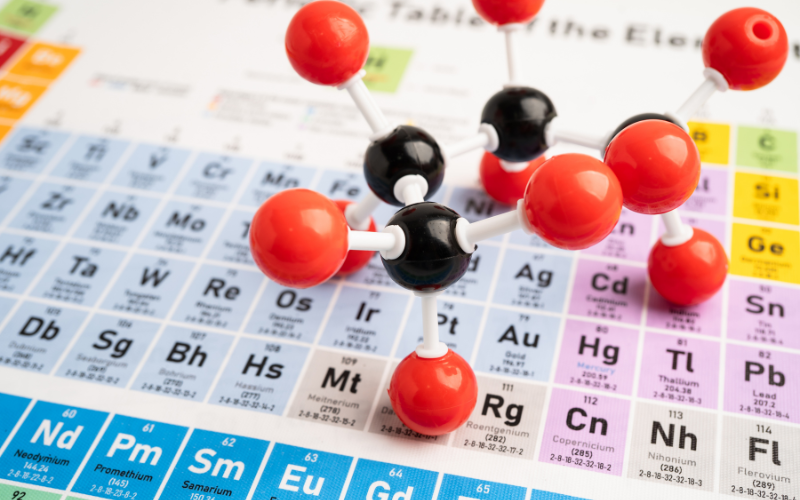
This is a complete condensed revision guide for AQA GCSE Chemistry Paper 1, sitting on Monday 18 May. It covers every topic in the Paper 1 specification from 4.1 to 4.5 with the key facts, definitions, formulas and distinctions you need to have locked in before you walk into that exam room. Read it alongside our companion tips post, which covers what to prioritise and how to avoid the most common mark losers.
Work through each topic section by section. After each one, close the page and try to recall the key points from memory. The act of testing yourself rather than re-reading is what moves content into long-term memory. Use this as a prompt, not a substitute for active recall.
Topic 4.1: Atomic structure and the periodic table
Atoms, elements and compounds
An atom is the smallest part of an element that can exist. An element is a substance made of only one type of atom. A compound contains two or more elements chemically combined. A mixture contains substances that are not chemically combined and can be separated by physical methods.
Common separation methods: filtration separates an insoluble solid from a liquid, crystallisation separates a soluble solid from a solution, distillation separates liquids with different boiling points, and chromatography separates dyes or dissolved substances.
Development of the atomic model
Know this timeline in order and be ready to explain what evidence caused each change:
- Dalton: atoms are solid spheres, different for each element
- Thomson: discovered the electron, proposed the plum pudding model — a positive sphere with electrons embedded throughout
- Rutherford: alpha scattering experiment showed most particles passed straight through, some deflected, a few bounced back — concluded the atom is mostly empty space with a small dense positive nucleus
- Bohr: refined the model by placing electrons in specific energy levels or shells
- Chadwick: discovered the neutron, completing the modern nuclear model
Subatomic particles
- Proton: charge +1, relative mass 1, found in nucleus
- Neutron: charge 0, relative mass 1, found in nucleus
- Electron: charge -1, relative mass very small, found in shells around nucleus
Atoms are neutral because the number of protons equals the number of electrons. Atomic number equals the number of protons. Mass number equals protons plus neutrons. Neutrons equal mass number minus atomic number.
Isotopes and relative atomic mass
Isotopes are atoms of the same element with the same number of protons but different numbers of neutrons. They have similar chemical properties because they have the same number of electrons and the same electronic structure.
Relative atomic mass is the weighted average mass of all isotopes of an element. The formula is: Ar equals the sum of (isotope mass multiplied by percentage abundance) divided by 100. Always multiply mass by abundance before adding.
Electronic structure
Electrons fill the lowest energy levels first. The first shell holds up to 2 electrons, the second and third shells hold up to 8. Key examples to memorise: sodium is 2,8,1; oxygen is 2,6; chlorine is 2,8,7; calcium is 2,8,8,2. The group number tells you the number of outer shell electrons, which determines reactivity and chemical properties.
The periodic table and group trends
Elements are arranged in order of atomic number. Elements in the same group have the same number of outer shell electrons and similar chemical properties.
Group 1 alkali metals: reactivity increases down the group because the outer electron is further from the nucleus and the electrostatic attraction is weaker, so the electron is lost more easily. They react with water to produce a metal hydroxide and hydrogen.
Group 7 halogens: reactivity decreases down the group because gaining an electron becomes harder as the outer shell is further from the nucleus. Displacement reactions follow the rule that a more reactive halogen displaces a less reactive halogen from its salt solution. For example, chlorine displaces bromine from potassium bromide solution.
Group 0 noble gases are unreactive because they have a full outer shell. Boiling points increase down the group.
Metals are on the left side of the periodic table, form positive ions and conduct electricity. Non-metals are on the right side, tend to gain or share electrons and are generally poor conductors. Transition metals sit between Groups 2 and 3. Compared with Group 1 metals they are harder, denser, stronger, have higher melting points, are less reactive and can form ions with different charges and coloured compounds. They are widely used as catalysts.
Stating that Group 1 reactivity increases down the group scores one mark. Explaining that this is because the outer electron is further from the nucleus, the attraction is weaker and the electron is lost more easily scores the rest. Always give the reason.
Topic 4.2: Bonding, structure and properties
Types of bonding
Ionic bonding involves the transfer of electrons between a metal and a non-metal, forming oppositely charged ions held together by strong electrostatic attraction in a giant ionic lattice. Covalent bonding involves the sharing of electron pairs between non-metal atoms. Metallic bonding involves positive metal ions surrounded by a sea of delocalised electrons.
Ionic compounds
Properties: high melting and boiling points because of the strong electrostatic forces between oppositely charged ions in the giant ionic lattice. They conduct electricity when molten or dissolved in water because the ions are free to move and carry charge. They do not conduct when solid because the ions are in fixed positions.
Simple molecular substances
Examples include water, carbon dioxide, methane and ammonia. Properties: low melting and boiling points because the intermolecular forces between molecules are weak. They do not conduct electricity because there are no free electrons or ions. The covalent bonds within the molecules are strong — it is the forces between molecules that are weak. AQA tests this distinction specifically.
Giant covalent structures
Diamond: each carbon atom is bonded to four others in a giant covalent structure. Properties: extremely hard, very high melting point, does not conduct electricity because there are no free electrons.
Graphite: each carbon atom is bonded to three others, forming layers. One electron per carbon atom is delocalised and free to move between layers. Properties: conducts electricity because of the delocalised electrons, soft and slippery because the layers can slide over each other, high melting point because of the strong covalent bonds within layers.
Graphene is a single layer of graphite. It is strong, flexible and conducts electricity. Uses include electronics and composite materials. Fullerenes are hollow structures of carbon atoms arranged in rings, used in drug delivery, catalysts and nanotechnology. Nanotubes are cylindrical fullerenes with very high strength-to-weight ratios.
Metallic bonding and alloys
Metals conduct electricity and heat because the delocalised electrons can move freely and carry charge or energy. Metals are malleable because the layers of positive ions can slide over each other without breaking the metallic bonds. Alloys are harder than pure metals because atoms of different sizes disrupt the regular arrangement of layers, making it harder for them to slide.
Nanoparticles
Nanoparticles are between 1 and 100 nanometres in size. They have a very large surface area to volume ratio, making small amounts highly effective. Uses include medicine, cosmetics, catalysts and electronics. Potential disadvantages include unknown health and environmental effects due to their small size and ability to penetrate biological membranes.
States of matter
Solids have particles in fixed positions, close together. Liquids have particles close together but able to move around. Gases have particles spread out and moving quickly. State symbols in equations: (s) solid, (l) liquid, (g) gas, (aq) dissolved in water.
Topic 4.3: Quantitative chemistry
Conservation of mass and balancing equations
No atoms are created or destroyed in a chemical reaction. The total mass of reactants equals the total mass of products. When balancing equations, only change the large numbers in front of each formula. Never change a subscript — that changes the compound itself.
If a reaction appears to show a change in mass, there is always a reason. If mass increases, a gas from the air has been added. If mass decreases, a gas has been released.
Relative formula mass
Relative formula mass (Mr) is calculated by adding together the relative atomic masses of all the atoms in a formula. Example: water (H2O) has Mr of (2 times 1) plus 16, which equals 18.
Moles (Higher Tier)
The mole is the unit used to measure amounts of substance. The formula is: moles equals mass divided by relative formula mass. Rearranged: mass equals moles multiplied by Mr. Always show the formula, the substitution and the answer with units.
Concentration
Concentration in g/dm3 equals mass divided by volume. For Higher tier, concentration in mol/dm3 equals moles divided by volume in dm3. Volume must be in dm3 — if given in cm3, divide by 1000 first.
Percentage yield and atom economy
Percentage yield equals actual yield divided by theoretical yield, multiplied by 100. Yield may be less than 100 percent due to reversible reactions, loss of product during transfer or side reactions producing other products.
Atom economy equals the relative formula mass of the desired product divided by the total relative formula mass of all products, multiplied by 100. A high atom economy means less waste and is more sustainable and economical.
Gas volumes (Higher Tier)
At room temperature and pressure, one mole of any gas occupies 24 dm3. The formula is: moles equals volume in dm3 divided by 24.
Write the formula first, then substitute the values, then calculate the answer. Include units at every stage. A correct final answer with no working shown can lose method marks if the examiner cannot follow your reasoning.
Topic 4.4: Chemical changes
Reactivity series
From most to least reactive: potassium, sodium, lithium, calcium, magnesium, carbon, zinc, iron, hydrogen, copper, silver, gold. More reactive metals form positive ions more easily and displace less reactive metals from their compounds. Carbon sits in the middle of the series and is used to reduce metal oxides of metals below it.
Metal reactions
Metal plus oxygen produces a metal oxide. Metal plus acid produces a salt and hydrogen. Metal plus water produces a metal hydroxide and hydrogen. More reactive metals react more vigorously. Copper, silver and gold do not react with dilute acids.
Extraction of metals
Metals above carbon in the reactivity series, such as aluminium and sodium, must be extracted by electrolysis because carbon cannot reduce them. Metals below carbon, such as iron, can be extracted by reduction with carbon in a blast furnace. Copper, silver and gold are found native in the Earth and require minimal processing.
Oxidation and reduction
At Foundation tier: oxidation means gaining oxygen, reduction means losing oxygen. At Higher tier, use OIL RIG: Oxidation Is Loss of electrons, Reduction Is Gain. These definitions apply to displacement reactions, electrolysis and all redox processes.
Acids and neutralisation
Acid plus metal produces a salt and hydrogen. Acid plus carbonate produces a salt, water and carbon dioxide. Acid plus alkali produces a salt and water only. The pH scale runs from 0 to 14. Acids have pH below 7, neutral is 7, alkalis are above 7. Strong acids such as hydrochloric, sulfuric and nitric acid fully ionise in water. Weak acids such as ethanoic and citric acid only partially ionise, so at the same concentration a weak acid has a higher pH than a strong acid.
Required practical: making salts
Steps in order: heat the acid, add excess insoluble solid, filter to remove excess solid, evaporate to reduce the volume of the solution, allow to cool so crystals form, filter the crystals and dry them. Excess solid is used to ensure all the acid is neutralised. The filter removes the unreacted solid. Key variables: concentration and volume of acid used, type of solid.
Titration
Titrations are used to find the exact volumes of acid and alkali that react together. Equipment: burette, pipette, conical flask, indicator. The endpoint is when the indicator permanently changes colour. Titrations are used to calculate the concentration of an unknown solution.
Electrolysis
Electrolysis uses electrical energy to decompose an ionic compound. The substance being electrolysed must be molten or dissolved in water so the ions are free to move. The cathode is the negative electrode where positive ions gain electrons and reduction occurs. The anode is the positive electrode where negative ions lose electrons and oxidation occurs.
For aqueous solutions at the cathode: if the metal is more reactive than hydrogen, hydrogen gas is produced. If the metal is less reactive than hydrogen, the metal is deposited. At the anode: if halide ions are present, the halogen is produced. If no halide ions are present, oxygen is produced from hydroxide ions in the water.
Higher tier half equations: at the cathode for copper, Cu2+ plus 2 electrons produces Cu. At the anode for chlorine, 2Cl minus produces Cl2 plus 2 electrons.
The most common error is stating what forms at each electrode without explaining why. Cathode: positive ions gain electrons, reduction occurs. Anode: negative ions lose electrons, oxidation occurs. For aqueous solutions, always state whether the metal is more or less reactive than hydrogen before deciding what forms at the cathode.
Topic 4.5: Energy changes
Exothermic and endothermic reactions
Exothermic reactions transfer energy to the surroundings. The temperature of the surroundings rises. Examples include combustion, neutralisation and oxidation reactions. Uses include hand warmers and self-heating cans.
Endothermic reactions take in energy from the surroundings. The temperature of the surroundings falls. Examples include thermal decomposition and dissolving certain salts. Uses include sports injury cold packs.
Reaction profiles
Activation energy is the minimum energy required for a reaction to start. On a reaction profile, the activation energy is the energy difference between the reactants and the peak of the curve. For exothermic reactions, the products are lower in energy than the reactants and the overall energy change is negative. For endothermic reactions, the products are higher in energy than the reactants and the overall energy change is positive.
Bond energies (Higher Tier)
Breaking chemical bonds requires energy input. Making chemical bonds releases energy. If the energy released making bonds is greater than the energy required to break bonds, the reaction is exothermic overall. If more energy is needed to break bonds than is released making them, the reaction is endothermic overall. Bond energy calculations: add up all bond energies broken, add up all bond energies made, subtract to find the overall energy change.
Chemical cells and fuel cells
Chemical cells produce electricity from chemical reactions between different metals or solutions. Batteries are made of multiple cells connected together. The greater the difference in reactivity between the two metals in a cell, the greater the voltage produced.
Hydrogen fuel cells combine hydrogen and oxygen to produce water and generate electricity with no harmful emissions. Advantages include renewable potential and zero carbon emissions at point of use. Disadvantages include the challenges of storing and producing hydrogen safely and the high cost of fuel cell technology.
Quick reference: formulas and key definitions
The following are the formulas and definitions most likely to be needed in Paper 1. Make sure every one of these is committed to memory before Monday.
- Neutrons: mass number minus atomic number
- Relative atomic mass: sum of (mass times abundance) divided by 100
- Relative formula mass: sum of all relative atomic masses in the formula
- Moles (HT): mass divided by relative formula mass
- Concentration (HT): moles divided by volume in dm3
- Percentage yield: actual yield divided by theoretical yield, multiplied by 100
- Atom economy: relative formula mass of desired product divided by total relative formula mass of all products, multiplied by 100
- Gas volume (HT): moles equals volume divided by 24
- Ionic bonding: transfer of electrons between metal and non-metal
- Covalent bonding: sharing of electron pairs between non-metals
- Metallic bonding: positive ions in a sea of delocalised electrons
- OIL RIG: Oxidation Is Loss of electrons, Reduction Is Gain
For targeted advice on how to approach each topic in the exam and the specific mistakes to avoid, read the companion tips post published alongside this guide.