This is a complete revision guide for AQA GCSE Triple Science Physics Paper 2 (specification code 8463), covering Topics 4.5 to 4.8: Forces, Waves, Magnetism and Electromagnetism, and Space Physics. This guide is for Triple Science students only. A separate Combined Science guide is available for those on that course. Content labelled Higher Tier only is for Higher students. Foundation students can skip those sections.
Work through each topic in order. After reading a section, close the page and try to recall the key equations and points from memory. Use the exam tips and common mistakes to sharpen technique alongside content.
Topic 4.5: Forces
Scalars and vectors
Scalars have magnitude only. Examples include mass, time, temperature, energy, distance and speed. Vectors have both magnitude and direction. Examples include force, weight, velocity, displacement and acceleration. Vectors are drawn as arrows where the length represents the size and the arrow shows the direction. Distance is a scalar; displacement is a vector. Speed is a scalar; velocity is a vector.
Contact and non-contact forces
A force is a push or pull due to an interaction between objects. Contact forces include friction, air resistance (drag), tension and normal contact force. Non-contact forces include gravitational force, electrostatic force and magnetic force. Forces always occur in pairs between two objects.
Gravity and weight
Weight is the force acting on a mass due to gravity.
Where W is weight in newtons, m is mass in kilograms and g is gravitational field strength in N/kg. On Earth, g is approximately 9.8 N/kg (sometimes taken as 10). Weight depends on location. Mass is constant everywhere. Weight acts through the centre of mass and is measured using a Newton meter (spring balance).
Resultant forces and free body diagrams
The resultant force is the single force that replaces all forces acting on an object. If the resultant is zero, the object is in equilibrium. If it is not zero, the object accelerates. Forces in the same direction are added. Forces in opposite directions are subtracted. Free body diagrams show all forces acting on an object with correct direction arrows and labels.
Work done and energy transfer
Where W is work done in joules, F is force in newtons and s is distance moved in metres. One joule equals one newton metre. Work done equals energy transferred. Friction transfers kinetic energy into thermal energy.
Forces and elasticity: Hooke's Law
Elastic deformation means the object returns to its original shape when the force is removed. Inelastic deformation leaves a permanent change in shape.
Where F is force in newtons, k is the spring constant in N/m and e is extension in metres. This equation only applies up to the limit of proportionality. Beyond this point, the relationship is no longer linear. On a force-extension graph, the straight-line section has a gradient equal to the spring constant. Elastic potential energy stored is:
Required Practical 6: force-extension (springs)
Aim: investigate the relationship between force and extension. Clamp a spring vertically, measure its original length, add masses gradually, record extension at each step and calculate force using F = mg. Plot force on the x-axis against extension on the y-axis. The proportional region gives a straight line with gradient equal to the spring constant. Sources of error include parallax when reading the ruler and the spring oscillating. Improve by waiting for the spring to reach equilibrium before taking each reading.
Moments, levers and gears
Where M is the moment in Nm, F is the force in newtons and d is the perpendicular distance from the pivot in metres. For equilibrium, the total clockwise moments equal the total anticlockwise moments. Levers multiply force or change the direction of force. Gears transmit rotational motion and can change speed or force.
Pressure in fluids
A smaller area produces higher pressure for the same force. Atmospheric pressure exists because the weight of air creates a force per unit area on all surfaces. Air is made of particles that constantly collide with surfaces, creating pressure. As altitude increases, there are fewer air molecules above, the air becomes less dense, fewer collisions occur and so pressure decreases.
Higher Tier only: pressure in a liquid increases with depth according to:
Where h is depth in metres, rho is density in kg/m cubed and g is gravitational field strength. This pressure difference causes upthrust, an upward force on objects submerged in fluids.
Distance, speed, velocity and acceleration
On a distance-time graph, gradient equals speed and a steeper gradient means faster speed. On a velocity-time graph, gradient equals acceleration and the area under the graph equals distance.
Newton's Laws of Motion
- Newton's First Law: an object with no resultant force remains at rest or continues at constant velocity
- Newton's Second Law: F = ma, where acceleration is proportional to force and inversely proportional to mass
- Newton's Third Law: every action has an equal and opposite reaction force on the other object
Required Practical 7: force and acceleration
Aim: investigate the relationship between force and acceleration, and between mass and acceleration. Use a trolley and pulley system with light gates to measure acceleration. Varying the hanging mass changes the force. Varying the mass of the trolley tests the effect of mass. Results confirm F = ma.
Stopping distance
Total stopping distance equals thinking distance plus braking distance. Thinking distance is affected by speed, reaction time, alcohol, tiredness and distractions. Braking distance is affected by speed, road conditions, tyre condition, brake condition and weather. Braking converts kinetic energy into thermal energy through friction.
Momentum (Higher Tier only)
Total momentum before a collision equals total momentum after. Airbags increase the stopping time, which reduces the force and reduces the risk of injury.
Topic 4.6: Waves
Transverse and longitudinal waves
A wave is a transfer of energy without transfer of matter. In transverse waves, oscillations are perpendicular to the direction of wave travel. Examples include electromagnetic waves, water waves and seismic S-waves. In longitudinal waves, oscillations are parallel to the direction of wave travel and the wave has compressions and rarefactions. Sound waves are longitudinal. It is the wave that travels, not the particles. Particles oscillate in place and energy is transferred through the medium.
Properties of waves
Amplitude is the maximum displacement from the equilibrium position and is related to the energy carried by the wave. Wavelength is the distance between identical points on the wave, such as crest to crest. Frequency is the number of waves passing a point per second, measured in hertz. Period is the time for one complete wave. Wave speed depends on the medium. When a wave enters a new medium, its frequency stays constant but its wavelength changes as its speed changes.
Required Practical 8: waves in a ripple tank or solid
Aim: investigate wave behaviour and measure wavelength, frequency and wave speed. In a ripple tank, produce waves using a motor generator and freeze motion using a strobe light or stroboscope. Measure wavelength from the frozen image and calculate wave speed using v = f times lambda. Higher frequency gives a shorter wavelength. Wave speed depends on the medium.
Reflection and refraction of waves
When waves reflect, the angle of incidence equals the angle of reflection. Waves can also be absorbed or transmitted. When light enters a denser medium such as glass it slows down and bends towards the normal. When it exits into a less dense medium it speeds up and bends away from the normal. This is refraction, caused by the change in wave speed at the boundary.
Required Practical 9: reflection and refraction of light
Shine a ray from a ray box onto a flat mirror and measure the incident and reflected angles to confirm they are equal. For refraction, shine a ray into a glass block, draw the incident and refracted rays, and measure how the angle changes as the light enters and exits the glass.
Sound waves
Sound is a longitudinal wave that needs a medium to travel and cannot travel through space. It travels as vibrations of particles creating compressions and rarefactions. The human hearing range is 20 Hz to 20,000 Hz. Higher frequency gives a higher pitch. Sound travels faster through solids than air because particles are closer together.
Ultrasound, seismic waves and echo sounding
Ultrasound has a frequency above 20 kHz. It is used in medical imaging: waves reflect at boundaries between tissues and the time delay is used to calculate distance and build up an image. Seismic P-waves are longitudinal and travel through solids and liquids. Seismic S-waves are transverse and only travel through solids. The fact that S-waves are not detected on the opposite side of the Earth provides evidence for a liquid outer core. Changes in P-wave speed provide evidence for the layered structure of the Earth.
Electromagnetic spectrum
All electromagnetic waves are transverse and travel at the speed of light in a vacuum. In order of increasing frequency: radio, microwave, infrared, visible light, ultraviolet, X-rays, gamma rays. Higher frequency means higher energy.
Uses: radio for communication; microwaves for cooking and satellite signals; infrared for heaters and thermal imaging; visible light for vision and fibre optics; ultraviolet for sterilisation and fluorescent lamps; X-rays for medical imaging; gamma rays for cancer treatment. High-energy EM waves (ultraviolet, X-rays and gamma) are ionising and can cause cell damage, cancer and DNA mutation.
Lenses (Triple Science only)
A convex lens converges light rays and can form real or virtual images. A concave lens diverges light rays and only forms virtual images. Magnification equals image height divided by object height. In ray diagrams for a convex lens, parallel rays converge at the focal point on the other side.
Visible light and colour
Visible light is a small part of the electromagnetic spectrum. Colours run from red (longest wavelength, lowest frequency) to violet (shortest wavelength, highest frequency). Specular reflection from smooth surfaces produces a clear image. Diffuse reflection from rough surfaces scatters light in many directions. Opaque objects reflect some wavelengths and absorb others: a red object reflects red and absorbs all other colours; a black object absorbs all wavelengths; a white object reflects all wavelengths. Transparent objects transmit most light. A coloured filter transmits its own colour and absorbs others.
Black body radiation
All objects emit and absorb infrared radiation. Hotter objects emit more infrared radiation per second and at higher frequencies. A perfect black body absorbs all radiation incident on it and is also the best possible emitter. A body at constant temperature absorbs and emits radiation at equal rates. Temperature rises when absorbed radiation exceeds emitted radiation and falls when emitted exceeds absorbed.
Earth's temperature depends on the balance between incoming short-wavelength solar radiation and outgoing long-wavelength infrared radiation. The atmosphere traps some infrared and increases temperature. Surfaces with high reflectivity (albedo) such as white or shiny surfaces reflect more radiation and absorb less.
Required Practical 10: infrared radiation and surfaces
Expose surfaces with different finishes (black, shiny, dull) to an infrared lamp and measure the rate of temperature change. Black and dull surfaces absorb more infrared and heat up faster. Shiny surfaces reflect infrared and heat up more slowly. This confirms that black surfaces are good absorbers and emitters and shiny surfaces are poor absorbers and emitters.
Topic 4.7: Magnetism and Electromagnetism
Permanent and induced magnets
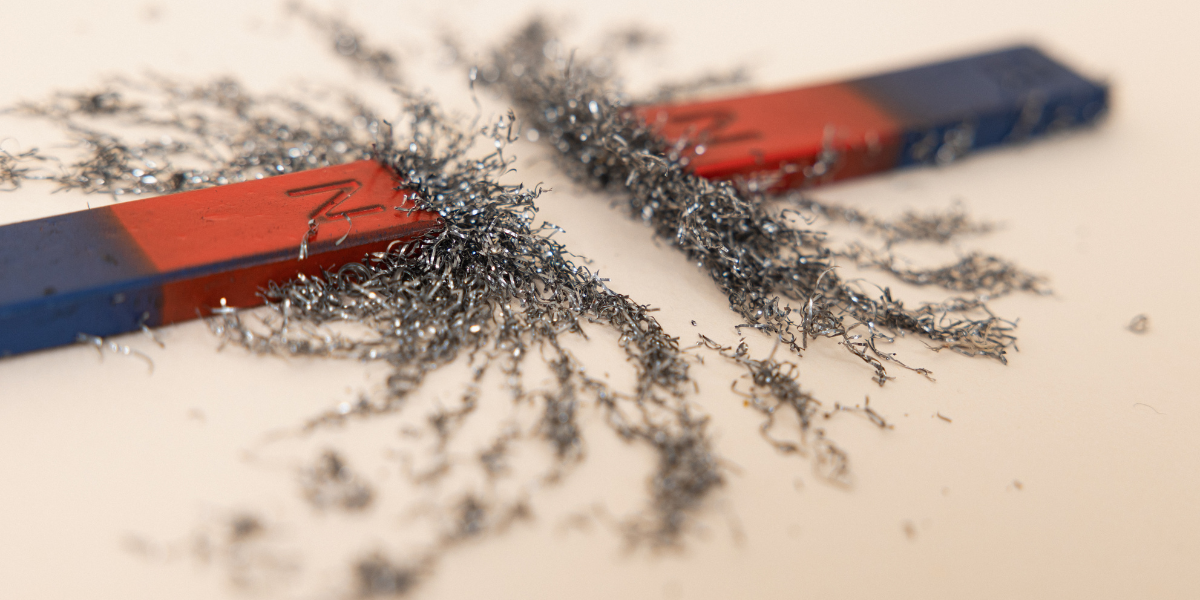
Every magnet has a north-seeking pole and a south-seeking pole. Like poles repel and unlike poles attract. Magnetic forces are strongest at the poles and weakest in the middle. A permanent magnet always maintains its magnetic field. An induced magnet only becomes magnetic when placed in a magnetic field and loses most of its magnetism when removed. Induced magnetism always causes attraction, never repulsion.
Magnetic fields
A magnetic field is a region where a magnetic force acts. Field lines go from north to south, never cross and indicate stronger fields where they are closer together. The Earth behaves like a giant magnet and a compass needle aligns with the magnetic field to point towards magnetic north. You should be able to plot field lines using a compass and draw field patterns accurately.
Electromagnetism
A current-carrying wire creates a magnetic field around it. Increasing the current increases field strength. Moving further from the wire decreases field strength. A solenoid is a coil of wire that produces a magnetic field like a bar magnet when current flows. The field inside a solenoid is strong and uniform. Adding an iron core makes the electromagnet stronger. Electromagnets are used in scrap yard cranes, relays and electric bells.
The motor effect (Higher Tier only)
A current-carrying wire in a magnetic field experiences a force. This is the motor effect. Fleming's Left-Hand Rule gives the direction: the thumb points in the direction of force (motion), the first finger points in the direction of the magnetic field (north to south) and the second finger points in the direction of conventional current.
Where F is force in newtons, B is magnetic flux density in tesla, I is current in amperes and l is the length of wire in the field in metres. A bigger current, stronger magnetic field or longer wire each produce a greater force.
Electric motors (Higher Tier only)
A coil carrying current in a magnetic field rotates because opposite forces act on opposite sides of the coil, creating a turning effect. The split-ring commutator reverses the current every half turn to keep the rotation in the same direction. Brushes maintain electrical contact with the spinning commutator.
Loudspeakers (Higher Tier only)
A loudspeaker converts electrical energy into sound energy. An alternating current flows through a coil in a magnetic field, causing the coil to move back and forth. This vibrates a cone which produces sound waves. The frequency of the alternating current equals the frequency of the sound produced.
Induced potential and generators (Higher Tier only)
A voltage is induced when a conductor moves in a magnetic field or when a magnetic field changes through a coil. The factors affecting the size of the induced voltage are the speed of movement, the strength of the magnetic field and the number of turns in the coil. An alternator produces alternating current and its output is a sine wave. A dynamo produces direct current and gives a steady positive voltage.
Microphones (Higher Tier only)
A microphone converts sound energy into electrical signals. Sound waves vibrate the diaphragm, which moves a coil in a magnetic field, inducing a voltage that represents the sound.
Transformers (Higher Tier only)
A transformer has a primary coil, a secondary coil and an iron core. A step-up transformer increases voltage. A step-down transformer decreases voltage. The National Grid transmits electricity at high voltage and low current to reduce energy losses in transmission cables, because lower current means less heating in the wires and less energy wasted as heat (I squared R losses).
Mixing up the direction of magnetic field lines (they go from north to south). Using the wrong fingers in Fleming's Left-Hand Rule. Forgetting the role of the commutator in keeping motor rotation in one direction. Not linking transformers to reduced power loss through lower current rather than higher voltage directly.
Topic 4.8: Space Physics (Triple Science only)
Our solar system
The solar system contains the Sun, eight planets, dwarf planets, moons, asteroids and comets. It formed from a rotating cloud of dust and gas called a nebula. Gravity pulled particles together to form a protostar, which became the Sun. Remaining material formed the planets. Inside the Sun, hydrogen nuclei fuse to form helium, releasing huge amounts of energy. A stable star exists in equilibrium because gravity pulling inward is balanced by radiation pressure pushing outward.
Life cycle of a star
Nebula, protostar, main sequence star, red giant, white dwarf, black dwarf.
Nebula, protostar, massive main sequence star, red supergiant, supernova, then either a neutron star or black hole.
Light elements up to iron are formed by nuclear fusion inside stars. Elements heavier than iron are only formed during supernova explosions, when the energy available is sufficient to fuse heavier nuclei.
Orbital motion and satellites
Gravity provides the centripetal force needed for a satellite to orbit. Natural satellites are moons held in orbit by gravity. Artificial satellites are used for communication, GPS navigation and weather forecasting. In a circular orbit, the speed of a satellite stays constant but the direction of its velocity continuously changes, so the velocity changes even though the speed does not.
For a stable orbit, the gravitational force equals the centripetal force needed. If speed increases, the orbit radius increases or the satellite escapes. If speed decreases, the satellite spirals inward.
Red shift (Triple Science only)
Light from distant galaxies is shifted towards the red end of the spectrum. This means the wavelength has increased and the frequency has decreased. It is caused by galaxies moving away from us. The faster the galaxy moves away, the larger the red shift. The greater the distance, the larger the red shift and the faster the recession. This is consistent with the Doppler effect applied to light.
The observation that most galaxies show red shift provides evidence that the universe is expanding. This supports the Big Bang theory, which states the universe began from a very small, hot and dense point and has been expanding ever since. Modern observations suggest the expansion is accelerating. Dark matter and dark energy are proposed to explain aspects of the universe that cannot be accounted for by visible matter alone.
Saying satellites need a constant force to keep moving. They do not. They are continuously falling toward Earth while also moving forward, which keeps them in orbit. Confusing speed and velocity in orbital motion: speed is constant but velocity is not because direction changes. Saying red shift means light turns red: it means the wavelength stretches towards the red end of the spectrum. Forgetting that elements heavier than iron are produced in supernova explosions, not in normal stellar fusion.
Quick reference: all equations for Physics Paper 2
- Weight: W = mg
- Work done: W = Fs
- Hooke's Law: F = ke
- Elastic potential energy: Ee = half ke squared
- Moment: M = Fd
- Pressure: p = F/A
- Liquid pressure (HT): p = h times rho times g
- Speed: v = s/t
- Acceleration: a = change in v divided by t
- Uniform acceleration: v squared minus u squared = 2as
- Newton's Second Law: F = ma
- Momentum (HT): p = mv
- Force and momentum change (HT): F = change in p divided by t
- Wave speed: v = f times lambda
- Period: T = 1/f
- Motor effect force (HT): F = BIl
- Transformer ratio (HT): Vp/Vs = np/ns
- Transformer power (HT): Vp times Ip = Vs times Is
Most common exam mistakes across all four topics
- Confusing scalar and vector quantities: velocity is a vector, speed is a scalar
- Saying weight and mass are the same: mass is constant everywhere, weight depends on gravitational field strength
- Using Hooke's Law beyond the limit of proportionality
- Forgetting that atmospheric pressure decreases with altitude because there are fewer air molecules above
- Confusing transverse and longitudinal waves: sound is longitudinal, light is transverse
- Saying the particles move with the wave: it is energy that is transferred, not matter
- Saying sound can travel through a vacuum: it cannot, it needs a medium
- Confusing P-waves and S-waves: S-waves cannot travel through liquids
- Saying induced magnets can repel: induced magnetism always causes attraction
- Using the wrong fingers in Fleming's Left-Hand Rule
- Forgetting the commutator reverses current to maintain rotation direction
- Saying the National Grid uses high voltage to save energy directly: it is the reduced current that reduces heating losses in the cables
- Saying satellites need a continuous force to keep moving in orbit
- Saying red shift means light turns red rather than wavelength stretching toward the red end
- Saying all elements heavier than hydrogen are made in stars: elements heavier than iron require supernova conditions